Pure Comfort
Monday, October 28th, 2013 Follow
A day like today calls for some serious comfort food. Here are a few of my childhood favorites – and these came out just about as good as my Mom’s!

Chicken Vegetable Soup

Apple Crisp

A day like today calls for some serious comfort food. Here are a few of my childhood favorites – and these came out just about as good as my Mom’s!
Chicken Vegetable Soup
Apple Crisp

Beef Barley Vegetable Soup
It’s getting to be soup weather, and this will definitely hit the spot after a good 60+ mile ride today. The morning started out pretty cool and calm, but the day warmed up and got a little bit breezy by the time I got home.
This soup is very easy to make and makes a hearty, satisfying, and healthy meal. It’s a variation of a previous post for Beef, Lamb, Vegetable, & Barley Soup. Use whatever vegetables, meat, and stock you have on hand. If you don’t have fresh vegetables, you can use frozen. You can add kidney or garbanzo beans, if you like. You could also substitute rice or pasta for the barley. You can easily make this vegetarian or vegan by omitting the meat entirely and using 100% vegetable stock. Mushrooms are a great addition, especially to the vegetarian version.
I’ll be serving this soup tonight garnished with a little freshly grated Parmesan cheese and some fresh herb rolls I picked up at the Nugget Market bakery today.
You can make a little, or you can make a lot. This soup reheats well and keeps in the refrigerator for a few days, and in the freezer for a few months. If you’ve got room in your freezer, make a big batch and stock up! The holidays are coming and we’ll all be extra busy and in need of a quick, healthy dinner. Simply remove from the freezer in the morning and thaw in the refrigerator. Reheat for dinner, serve with some crusty bread, and you have a quick, healthy, satisfying dinner.
I woke up to a chilly, very breezy morning in Davis, and we even had a bit of rain last night. It’s getting to be soup weather – just in time for Fall 2013 Quarter at UC Davis! This makes a large batch of soup and the leftovers will freeze well. This soup will be great fuel for studying, so load up on veggies this Saturday at the Davis Farmers’ Market and make a batch this weekend. Remember to freeze some individual servings to keep on hand for midterm time.
Beef, Lamb, Vegetable, & Barley Soup
1 tablespoon olive oil
2 large carrots, diced
2 large ribs of celery, diced
1 large yellow onion, diced
1 pound of lean beef, cut into about 1/2 inch cubes
1/4 pound lean lamb*, cut into about 1/2 inch cubes
1/2 to 1 cup each: peas, corn, string beans, (fresh or frozen)
2-3 cups of fresh baby kale, coarsely chopped
8 ounces of barley**
2 quarts of beef broth
1 28-ounce can of crushed tomatoes
fresh herbs, chopped (parsley, rosemary, thyme, etc.)

Hearty, nutritious, and delicious!
Clean and dice the carrots, celery, and onion; set aside. Heat the olive oil in a large stock pot. Add the carrots, celery, and onion and cook on medium-low heat until they’ve softened a bit. Remove from pot and set aside.
Depending on your pot, you may want to add just a touch more oil to prevent the meat from sticking. Increase the heat to medium-high and add the meat. You’ll want to brown it a bit.
Reduce heat to medium-low and return the carrot mixture to the pot. Add the remaining vegetables. If you’re using frozen vegetables, you’ll want to thaw and drain them a bit before adding to the pot. Add the barley and stir to combine.
Add the stock and tomatoes and give a good stir. Cover and cook over medium-low heat until the barley is tender. Give a stir now and then. A little bubbling is OK, but you don’t want this to boil; that would overcook the vegetables. Cooking time will be at least an hour, even if you use a quick cooking barley.
While the soup is cooking, prepare the biscuits. When I’m pressed for time, I like to use the Trader Joe’s multi-grain pancake and waffle mix as a base for biscuits. This makes a nice biscuit on its own, or you can easily dress them up with just a few modifications. I increased the amount of milk called for by about 20% and substituted about half of that with non-fat Greek yogurt. For flavor, I used olive oil and about 1 teaspoon of my favorite Herbs de Provence mix. Mix and bake as directed on the package. They had great flavor and a nice, tender crumb.
For my vegetarian and vegan friends – you can easily make this vegetarian or vegan. Simply omit the meat and use vegetable broth. For added protein, you could add beans, which combined with the barley will give you complete protein. For texture and flavor, some shiitake mushrooms would be fantastic.
* If you’re not a fan of lamb, then simply omit it.
** I used Trader Joe’s 10-Minute Barley.
I’ll post the recipes soon …

Beef, Lamb, Vegetable, & Barley Soup*

Whole Grain Herbs de Provence Biscuits
* The soup can easily be made vegetarian (or vegan) by omitting the meat and substituting vegetable broth. I guess you could use a texturized vegetable protein if you want a meat-like texture. Even better yet, a nice, “meaty” and flavorful mushroom would be divine!
If ever weather called for homemade soup and bread, it is now. We’ve been having quite the little storm here in Northern California, so yesterday I made a super healthy chicken vegetable rice soup and a batch of whole wheat bread with a hint of oat bran, polenta, and pumpernickel.

Hearty, healthy, and delicious!
For the soup, I precooked some short grain brown and black rice in my rice cooker (positively one of the best kitchen inventions EVER!). I sauteed in a little olive oil some carrot, celery heart, and crimini mushrooms just to soften a little. I set these aside, and in the same big soup pot, I sauteed 3 chicken sausages and about 4 ounces of leftover herbed chicken breast from the night before. I used Trader Joe’s chicken sausages (2 sundried tomato and 1 smoked apple chardonnay, but you can use whatever brand or flavor you like). I sliced them into about 1/4-inch slices, then in half, and sauteed them just enough to heat them through and brown them just a bit for flavor. I added back the vegetables, about 1 cup each of frozen peas and green beans, and some baby kale, chard, and spinach (Trader Joe’s Power to the Greens), and some fresh thyme. I sliced a few cherry tomatoes in half (Trader Joe’s heirloom cherry tomatoes), then used about 2 1/2 quarts of organic chicken stock (Kirkland brand). I let it cook gently while I finished up the bread.
The bread is based on the Tassajara Bread recipe, with a couple of variations.
3 cups filtered or bottled water, room temperature
1 1/2 tablespoons dried yeast
1/4 cup honey
1 cup dry milk
1/2 cup oat bran
1/2 cup polenta
1/2 cup pumpernickel flour
1 1/2 cup whole wheat flour
4 teaspoons salt
1/3 cup butter, melted & cooled
2 cup whole wheat flour
1/2 to 1 cup flour
additional flour as needed for kneading
Prepare the sponge:
While the sponge is proofing, melt your butter, then set aside to cool. Combine 2 cups of whole wheat flour with the salt. When the sponge looks “proofy” (starting to bubble and rise), add the melted butter on low speed (or stir in by hand) until mostly combined. Then, add the flour and salt mixture 1/2 to 1 cup at a time. If you’re using a mixer, do this on low speed. If you doing it by hand, stir it in with a large, heavy wooden spoon. When you can no longer stir it in with the spoon, you can work it in with your hands.

Just out of the mixer
This dough turned out to be fairly wet, so I ended up using at least 1 cup additional flour. It’s important to go by feel, not just by measurement when you’re making bread. It takes some practice, but once you get the feel of dough, you just know. Flour varies a lot by brand and type, so you can’t always measure exactly and expect consistent results. I used a combination of King Arthur and Guisto’s flours; both are premium flours. King Arthur flours are available in pre-packaged bags, and Guisto’s flours are usually in bulk.
Both of these brands are available online:
Guisto’s: http://giustos.com/home_baker
King Arthur: http://www.kingarthurflour.com/
I mixed this dough a long time on low because it was so wet, then finished it with about 3 minutes on high speed. I used my KitchenAid stand mixer, but this is a great dough to do by hand, also. It’s very satisfying to handle; it just feels good. Turn the dough out onto a floured board. You want to use enough flour to prevent the dough from sticking, but be careful to not use too much; you don’t want to work too much more into the dough.

The polenta adds a nice, slightly sweet crunch.

After the first rise.
Shape the dough into one large ball and place in a large, lightly oiled bowl. Cover loosely with plastic wrap, then with a towel. Allow to rise about 45 minutes, then “punch down” the dough by gently pressing down on it. Then, fold the dough over itself, keeping the smooth top up. Recover and allow to proof another 45 minutes to 1 hour.
This batch will make two large loaves (9 1/4 x 5 1/4-inch loaf pan), or as many smaller loaves, or rolls, as you care to make. I like to use about half of it in a loaf pan, and then make 1 or 2 more rustic loaves that I proof in a baker’s couche (a linen cloth made for proofing yeast doughs). You can use a towel (the flour sack kind, NOT terry cloth!) to create a make-shift couche. Generously flour the couche. For this dough, I used whole wheat and pumpernickel flours, and for one of the loaves I also sprinkled on some polenta. Place the shaped dough top down (seam up) on the floured couche.

My make-shift couche, dusted with whole wheat and pumpernickel flours, & polenta.

Free form loaf.
Cover loosely with towels so the loaves don’t dry out too much. With the couche, the dough will dry out just enough to allow a really nice crust, but you want to make sure you don’t expose the dough directly to the air or it will dry out, creating an unattractive crust. If you’re using loaf pans, you’ll want to cover lightly with plastic wrap. Remember, the dough will rise again, so you don’t want to restrict it by covering it too tightly.
The dough will need to rise about 30 minutes, so start preheating your oven after about 20 minutes. You’ll want to bake the rustic, couched loaves first. They’ll need a hot oven (400-450 degrees) and a preheated baking sheet. If you have a baking stone or tile, that’s best, but you can also turn a professional sheet pan over and place that in the oven while it’s heating. A half-sheet pan will fit in most home ovens. I have one that I have sacrificed for this; it’s the oldest of the sheet pans I have, so it’s not in great shape, anyway, but it works like a charm for this.
When the oven is ready, place a sheet of foil on a baking peel and gently transfer the dough to the peel. This dough is sturdy enough that you can do this by hand, but if you have a delicate dough (like a ciabatta) you will want to use a hand peel to transfer the dough from the couche. Place the dough seam down on the foil. Score with a razor or very sharp knife.

Ready to score ...

Ready to score ...

Scored and ready to bake!
Transfer the scored loaves to the oven. I bake them on the foil on the inverted, preheated baking sheet. You want to keep as much heat in the oven as possible, so quickly spritz the dough with water or throw a couple of ice cubes on the bottom of the oven. If you use a spray bottle, be very, very careful to NOT spray the light bulb in the oven! It will shatter and your bread will be ruined. I speak from experience. After about 5 minutes, you can throw 2-3 more ice cubes in the bottom of the oven, or spritz with a little more water. What this does is to help to mimic that nice, chewy crust you get in breads baked in a professional oven.
Bake until the loaves are a nice, golden brown. They’re done when they sound hollow when you give the loaf a little thump on the bottom crust.

Fresh out of the oven. Smells so good!

Be sure to allow the bread to cool at least most of the way before you slice into it.

Now here is a little slice of heaven!
This will
warm you,
fuel you, and
nourish you.
Enjoy!
Original Thanksgiving plans included a trip to Sonoma County. Those plans changed unexpectedly and last minute. We learned late morning while we were on a ride that the meal was going to be served mid-afternoon. This just might be an important detail to let your guests who are traveling from out of town know ahead of time, but … all is well that ends well. So, we found ourselves without any of the traditional Thanksgiving makings and certainly did not want to head to the store, or out to find an open store, after riding, so on our way back we rolled through Downtown Davis to see who might be open.
I was a little cranky already, because the wind proved to be a bit much for me yesterday on the ride. I really don’t understand how sometimes it doesn’t look that windy, but it feels like I have my own personal gale force winds. I guess it’s just one of those mysteries. Luckily for me, I had a riding partner who stayed just far enough ahead of me to not hear me whining out loud, “This sucks! I am NOT having fun!” But not so far ahead that I felt alone out there in my very own personal tornado.
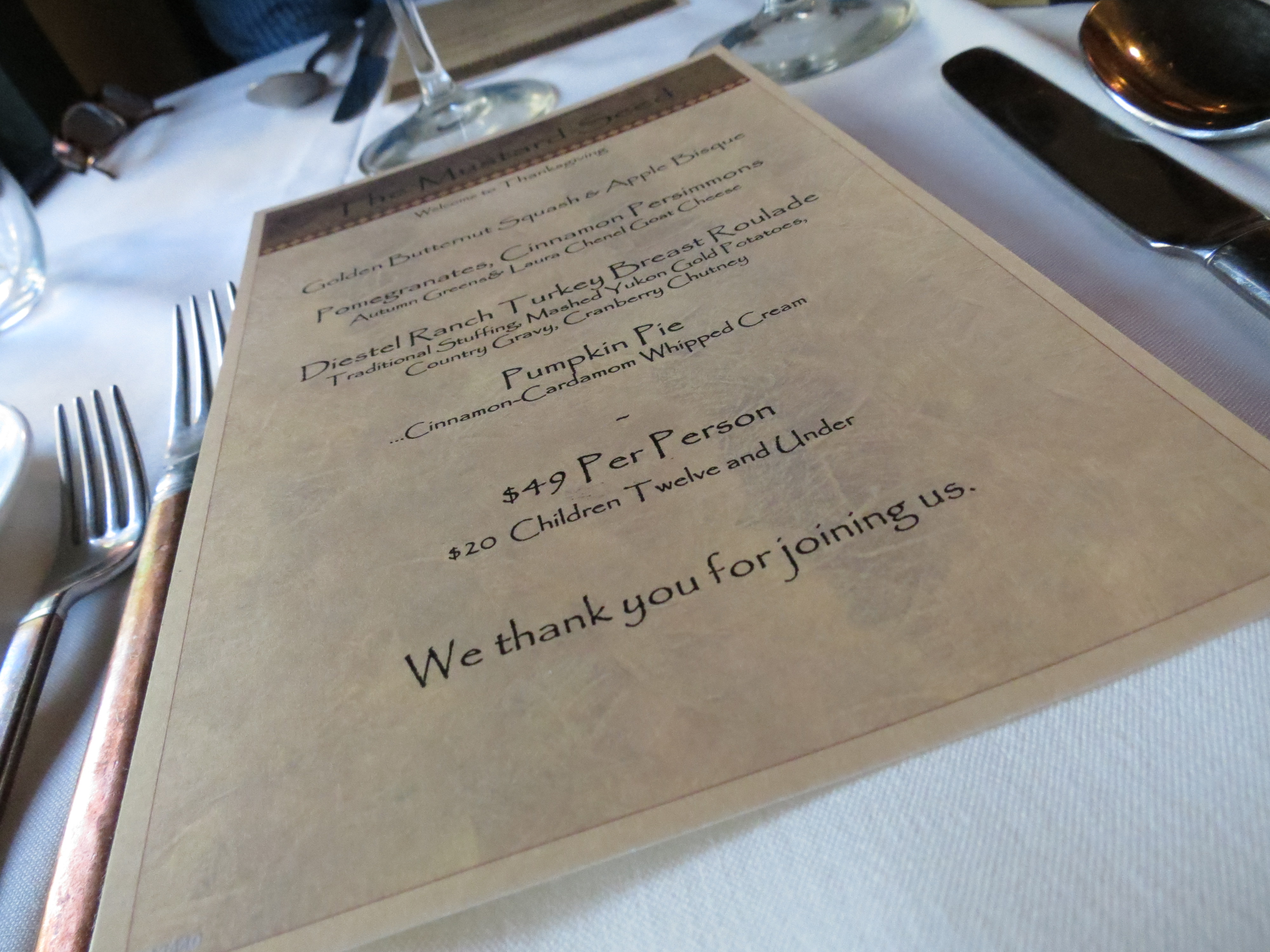
Thanksgiving Dinner Menu
After the ride, a quick check online showed that there was still a reservation available at 4pm at The Mustard Seed in Downtown Davis. The menu promised a “traditional” Thanksgiving menu. I must admit I had a few reservations of my own, because when it comes to “traditional” stuffing, I have rules. Besides, dinner at 4pm? Hmph.
I groused and grumbled around for a while in the afternoon and decided to take my frustration out on that nagging spot on the laundry room floor, rather than share my general unpleasantness with someone who was going to great lengths to be very sweet to me. The good news is that the laundry room floor looks great!
Traditional. Hmph. We’ll see.Wish I had just made the meal myself. Next year.

Table Setting
 Candle Light

A Nice View
We arrived promptly and were seated right away at a lovely table by the window, overlooking the patio tables. The table setting was elegant and simple. Service was friendly and professional.
We enjoyed a Cazar Pinot Noir (2010), which went nicely with each course.
First Course: Golden Butternut Squash and Apple Bisque. Normally, I am not much for bisques, because they tend to be too rich for me, but this one had a nice balance of savory and sweet and was not too rich.

Golden Butternut Squash & Apple Bisque

Clearly, we didn't like this at all.
Second Course: Pomegranates, Cinnamon Persimmons, Autumn Greens & Laura Chenel Goat Cheese. The pictures say it all … I could feel every last trace of grumpiness leave. This was the kind of salad I would make for myself. Fresh, crisp greens. Fruit. Cheese. Perfectly lightly dressed.

Autumn Greens, Persimmons, Pomegranate, Goat Cheese

Obviously, we didn't really like this one, either.
Main Course: Diestel Ranch Turkey Breast Roulade, Traditional Stuffing, Mashed Yukon Gold Potatoes, Country Gravy, & Cranberry Chutney.

With gravy ...

Gravy on the side ...

Looks promisingly traditional
I was surprised by the generous portions served. There were two large slices of turkey breast, and generous sides of roasted brussel sprouts, stuffing, mashed potatoes, and cranberry chutney. Everything tasted homemade from scratch, like I would make. Even the gravy was good; it was rich and flavorful without being too heavy.
The brussel sprouts were tender and perfectly roasted. Brussel sprouts are devine when they are cooked right, but they tend to have a bad reputation because so many people overcook them. My favorite way to prepare them is roasting, and these were cooked exactly how I like them cooked. I tried really hard to leave a couple for leftovers today, but that didn’t happen.
The stuffing … I hate to admit, but this was as good as my own. I grew up with this style of stuffing, and so very few people get this right (in my ever-so-humble opinion). So, any doubts about “traditional” were completely dissolved after just one bite. You’ve won me over.

Try as I might to finish, I just couldn't quite do it.
Cranberry chutney … I grew up hating cranberries because we always had to endure that slimy, jellied glop that slides out of a can. At some point my family discovered fresh cranberries, and we experimented a bit with a few recipes, and some came out pretty good, but I was never that big of a fan of cranberry relish or chutney. I have to say, though, that this chutney was wonderful. Tart, sweet, cooked just right.
Mashed potatoes … perfect.
And then there was pie …

Pumpkin Pie with Cinnamon-Cardamom Whipped Cream

It's a shame, but we didn't really like this, either. But just to be safe, we requested that the second one be packed up to take home so we could sample it again today, just to be sure.
So, after all that … I had better get ready for a big bike ride today!

Chicken Rice Soup
My soup recipe from last Thursday was requested. I rarely ever follow a recipe when I make soup, I just sort of go with what I have on hand. I had a few chicken bones in my freezer left from a chicken I had boned a month or two back. I simmered them in a little water with a few sprigs of fresh rosemary and thyme, and about 6 peppercorns. I simmered this slowly until I had a very simple, light broth.
Also in the freezer, there were some frozen peas and edamame. I placed these in a colander to thaw and drain.
Normally I would cook the rice in the soup, but since I was starting late, I cooked the rice separately in my rice cooker. I used a Lundberg blend, Black Japanica (http://www.lundberg.com/products/rice/gourmet_rice_blends/Lundberg_Black_Japonica%E2%84%A2.aspx), which is what gave this soup such a dark color. I love using these dark rices. They add a richness and depth of flavor that ordinary rice just can’t touch. As an added bonus, they are nutrient-rich and loaded with antioxidants. My rice cooker takes about 45 minutes to cook a batch, so I started this right after the broth was going.
While the broth and rice were cooking, I chopped one onion into about 1/2 inch cubes, sliced 3 stalks of celery, and about 12 baby carrots (because that’s what I had … normally I would use 2 regular carrots). I sauteed these in about 2 tablespoons of good extra virgin olive oil, just until a bit softened. While these were sauteing, I diced about a 1-inch chunk of fresh ginger into small cubes (1/8 inch?), and chopped some fresh thyme and rosemary. Set the ginger and herbs aside for now.
When the broth is ready (you’ll just know), add the peas and edamame to the vegetables. Stir in the fresh ginger, herbs, and give a nice grind of fresh peppercorns. Strain the broth into the vegetables, set the bones aside to cool a bit. Add 1 more quart of chicken broth or stock. If you don’t have any bones on hand to make broth, then just use store bought. You’re going to want a total of about 2 quarts stock for this recipe.)When the chicken bones are cool enough to handle, pull off any meat that’s left on the bones and add it to the soup.
When the rice is done, add it to the soup. Heat the soup through, but you don’t want to boil it.
Ladle the soup into bowls, garnish with a bit of fresh parsley. A little hot sauce is good, too. Enjoy with some good homemade bread!
This recipe can easily be made vegan by using a vegetable broth and no chicken. It is a good, healthy source of complete protein (rice and peas) as well as the edamame beans.
Hopefully this will fix things so I can ride this weekend …

Homemade Chicken Soup, with mahogany rice, ginger, and vegetables.

A variation on the Piadine Dough. I doubled the rye and whole wheat, and reduced the white bread flour. I also tried a slightly different method, sort of combining an autolyse and sponge methods. I'll post details later.
Tonight I made a variation on the dough I made a few weeks ago (see: http://cyclingfoodie.com/2012/09/guess-whats-for-dinner-tonight/). I used 1 tablespoon of rye flour, 1/2 cup of whole wheat flour, and the rest (except for dusting) unbleached bread flour. Oh, this dough feels, smells, and tastes amazing.

Fresh out of the mixer ...

Gently shaped ...

Getting ready for the first rise ...

Fully risen ...

Gently shaped and dimpled for focaccia ...

... a few green olives, a little coarse sea salt, a generous splash of extra virgin olive oil ...

Voila! The finished focaccia.
Preheat your oven to 400 degrees Fahrenheit. Allow the focaccia to rise about 10-15 minutes while your oven heats. Bake about 25-35 minutes.

A twist on Giada's Winter Minestrone Soup ... see http://www.foodnetwork.com/recipes/giada-de-laurentiis/winter-minestrone-recipe/index.html
Serve with fresh, hot Minestrone Soup. Tonight’s soup is a twist on Giada’s Winter Minestrone Soup. I had to substitute some ingredients (baby kale for chard) and I didn’t quite follow the exact proportions (doubled the tomatoes). All I can say is that it sure smells good in here now.
There’s a cool breeze tonight that’s leaving me longing to make some soup this weekend. I have some beautiful baby kale, so I’m thinking a modified Minestrone? Oh, how I wish I had all of my cookbooks here so I could use my favorite Minestrone recipe. It’s from a book called “Soup Salad & Pasta” by Ursel Norman. This is one of my favorite cookbooks.

My Tassajara Bread (circa April 2010)
Oh, and bread … definitely some bread, too. I’m thinking some Tassajara whole wheat … a true classic. The ultimate comfort food. The Tassajara Bread Book was my very first bread book. What I love about this book is that it gives very detailed directions on basic bread making skills. Once you master these basic skills, the world is your loaf!
I miss my cookbooks … sigh …


