
 Follow

Banana Oat Bread
April 14th, 2013
I’ve got a cold so I won’t be doing much riding today … oh, well. I guess it’s best to get it over with before my Tour de Cure ride! I had been fighting the cold all week, it seemed to start winning Thursday night and Friday, but seriously oversleeping on Friday and then early, early to bed Friday night and I thought I had turned a corner. I went for a pretty good ride yesterday (78.1 miles total). Certainly not a record-setting ride in any sense, but I rode steadily and reasonably strong, given the circumstances.
What to do to keep busy today? I have lots of chores I can do, but I’m looking for something a little fun, too. I’ve got some ripe bananas, a whole lot of oats, and some buttermilk I really need to use. So … a quick Google search “banana oat bread” turned up a few ideas.

Smells good!
Banana Oat Bread
1 cup whole wheat flour
1/2 cup all purpose flour, unbleached
1/3 cup coconut sugar
1/3 cup pure cane sugar, unrefined
1 1/2 teaspoon baking powder
1/4 teaspoon baking soda
1/4 teaspoon salt
2 teaspoons of apple pie spice blend
3/4 cup whole rolled oats
2 ripe* bananas, mashed
1/3 cup buttermilk
1/4 cup vegetable oil
2 teaspoons vanilla
2 eggs, beaten
A handful of oats and some additional sugar for sprinkling on top of the loaf before baking
- Preheat oven to 350 degrees. Prepare the loaf pan – spray with cooking spray.
- Combine the dry ingredients in a large mixing bowl.
- Mash the bananas in another bowl, stir in the beaten eggs, buttermilk, oil, and vanilla. Mix well.
- Add the wet ingredients to the dry ingredients and stir until just combined. Don’t over-mix or the bread will be tough.
- Pour into prepared loaf pan. Sprinkle the top with a handful of oats and sprinkle with about 1 tablespoon of sugar.
- Bake in the center of the preheated oven for about 50-55 minutes. The loaf is done when a toothpick inserted in the center comes out clean.
- Cool on a wire rack for about 15 minutes, then remove from the pan. Let the loaf cool before slicing into it.

Allow to cool most of the way and use a sharp serrated knife.

This bread is moist and has a nice, tender crumb.
Using the whole grain flour and coconut sugar, as well as the spices, produces a darker loaf than if you’re using all white flour and sugar. My first attempt at this recipe and it is a keeper! It is hearty, yet light and wholesome. It is flavorful and not too sweet. This is a variation of a recipe I found online here.

Napa Valley Tour de Cure, 2012
Three weeks from today I will be riding in my 5th Napa Valley Tour de Cure. I feel quite unprepared for the ride this year and I am not even close to my fundraising goal. I’ve got just 3 weeks to get ready. Here’s hoping I am 100% over this cold by next weekend, and that the weather cooperates! I am really, really hoping for good weather again this year for the Tour de Cure.
* A note about “ripe” bananas … I am really, really fussy about bananas. I like to eat them at the perfect ripeness (for me) – a lovely yellow peel, no (or at most very little) green, and no (or at most very few) brown speckles. Once there are more than a few brown speckles, they’re too ripe for my tastes for just eating. They’re OK for smoothies, and with a few more speckles, perfect for bread. So, that’s what I consider “really ripe” and ready for banana bread. If your bananas’ peels are entirely brown (or *gasp* black) and the flesh is mushy, they’re too ripe. Overly ripe bananas can give your bread a heavy texture.
Bicycle Helmet Do’s & Don’ts
April 9th, 2013
I always wear my bicycle helmet to protect my head. Here is some great advice from the Mayo Clinic about how to choose and wear a bike helmet. Remember … “A bicycle helmet only works if you wear it correctly. Here’s the lowdown on bicycle helmets, from choosing a bicycle helmet to avoiding common helmet mistakes.” For the full article, please click here.
Multigrain Bread Recipe
April 3rd, 2013
This past weekend I made a variation on the Tassajara Bread recipe. You can mix this dough by hand, or use a stand mixer. If you’re using a mixer, make sure it’s got a strong motor. I have a KitchenAid professional model, and this dough was just about all it could handle. You might want to make a half batch if you’ve got a smaller mixer, or are mixing it by hand.
Multigrain Bread
3 cups filtered water, room temperature
1 1/2 tablespoons active dry yeast
1/4 cup honey
1 cup dry milk
1/2 cup pumpernickel flour
1/2 cup oat bran
1/2 cup millet
1/2 cup polenta
2 cups high protein whole wheat flour
4 teaspoons kosher salt
1/3 cup butter, melted & cooled
3-4 cups whole wheat flour
1 cup white bread flour for kneading
- In the bowl of a stand mixer, sprinkle the yeast over 1 cup of the water and let it stand about 10 minutes.
- Add the honey, dry milk, and remaining water and mix a bit to dissolve the milk powder.
- Mix in the pumpernickel flour, oat bran, millet, polenta, and 2 cups of high protein whole wheat flour. Mix until the ingredients are well incorporated, but don’t over mix at this stage. You don’t want to develop a lot of gluten yet. Let rest for about 20-30 minutes. You can use either the paddle or dough hook for this stage, but you will probably find that the paddle mixes the sponge together a bit easier than the hook.
- Sprinkle the salt on top of the sponge, pour in the melted butter, then turn the mixer on low. You’ll want to use the dough hook at this point.
-

Just out of the mixer
When the salt and butter are mostly incorporated, begin adding the flour, about 1 cup at a time. This is going to be a pretty sticky dough, but remember that the millet, polenta, and oat bran will continue to absorb moisture as the dough mixes and proofs. Avoid the temptation to make the dough feel “right” just out of the mixer. It should be pretty soft and a bit sticky.
- Mix on low for about 10-15 minutes, then turn the mixer on high for about 2 minutes. Don’t walk away from the mixer at this point, though it might be tempting to do so.
-

Turn the dough out onto a lightly floured board and shape into one large round. Place in a large, lightly oiled bowl, and cover with plastic wrap and a towel. Place in a draft-free area. I prefer to let my dough rise slowly, so I don’t go out of my way to find a warm place in my kitchen to proof the dough.
- Allow the dough to rise about 50 minutes or so, until it’s doubled in size.


Ready to "punch down."

To “punch down” the dough, gently push down on the dough to press out the excess gas. Then, gently lift the dough and tuck the sides under. You’ll do this so that you pretty much form a squarish envelope shape. Keep the smooth side up. Gently press down on the dough again with the palms of your hands, to help seal the bottom. Recover with the plastic wrap and towel. Let the dough rise until doubled in size again for 30-45 minutes.

My make-shift "flour sack" couche, dusted with whole wheat flour, rolled oats, and polenta.
When the dough has just about doubled in size again, you’ll shape it. I like to shape into a basic loaf shape, sometimes called a “miche.” You can also shape the dough into rounds (“boule”), if you like. Once the dough is shaped, you’ll set it aside for its final rise. Again, times will vary. Since I can only bake at most 3 small loaves at a time, I will shape some a little tighter. These will rise a little slower. That way, I have time to proof and bake the first loaves. They’ll take about 30 minutes to rise, and then another 20-30 to bake.
If you time it just right, the second half will be perfect and ready to go in as you pull out the first loaves.
To bake the dough, use a hot oven (400 to 450 degrees) and preheat it well. For smaller artisan style loaves, use a preheated baking stone or tile. You’ll want a slightly lower temperature for a large loaf baked in a pan. I also like to throw a couple of ice cubes on the bottom of the oven immediately after I put the dough in to bake. Be sure to shut the oven door right away to hold the heat and steam in. This simulates a steam-injected oven that professional bakeries use to create that wonderful crust.

One large loaf, proofed and ready!

Egg wash will give the finished loaf a nice, shiny glaze.
This batch makes enough for two large loaves (9.5 x 5.5 x 2.5-inch loaf pans). I always like to make a few smaller loaves and proof them in towels dusted with polenta and flour. This mimics an artisan loaf that you’ll find in a good bread bakery. You’ll want to use either linen couches or some basic “flour sack” type towels.
I usually make two or three smaller, rustic loaves, and one large loaf. It is important to use a very sharp knife (or better yet, a razor blade) to get nice, even scores on the dough. Scores should be about 1/4 to 3/8-inch deep, depending on the size of the loaf. This will result in a beautiful finished loaf.
Homemade bread may seem intimidating, but this recipe really is pretty forgiving, and is great for bread bakers of every level! Proofing times are estimates and will depend on various factors, including the temperature of the water you use and the room temperature.

You CAN make artisan quality bread at home!

Look at that beautiful glaze!
First Post-Work Ride of the Season
April 2nd, 2013I got my first post-work ride of the season in last night. Oh, that felt good! Just a quick about 18 mile jaunt around East Davis. No photos, just cycling. That’s a bit of a shame, though, because it was a stunning sky last night – big poofy clouds just starting to turn sunset pink.
It’s looking like I’ll be able to get another one in tonight, too.
Multigrain Bread
April 1st, 2013
Today was a great day for baking and doing a bit of much needed spring cleaning.

Early afternoon the sky began to clear ...

Oh, my! Now I was glad I'd stayed home!
The weather was rather unpredictable today. We had wind, rain, sunshine, thunder & lightning, and downpours. There were moments when I wished I was outside riding, but then the skies opened up and I was thankful to be home and safe and dry.
The recipes and photos will have to come later because WordPress has decided to stop working and won’t post photos correctly, but I had a busy day in the kitchen with homemade whole grain bread, chocolate chip cookies, and kale slaw – getting ready for a potluck at work tomorrow.

Kale Slaw

Multigrain Bread

Chocolate Chip
March Madness, Day 24
March 25th, 2013
Today 85.5 miles. I am now at 60% of my goal of 750 miles for March Madness. I highly doubt that I will be able to ride 300 miles this week when I will be working every day, including Saturday, leaving only next Sunday 3/31. Oh, well.

Hiking the Training Hill in Auburn, CA
Saturday it was too windy in Davis for me to ride. I probably should have just driven to the Napa Valley to ride the Tour de Cure route (or part of it at least!), but I went to Auburn and hiked with a friend. I haven’t seen her in a long time and it was a nice change of pace. I do need to do more cross training.
Today I rode from Davis to Winters to Vacaville to Pena Adobe Park and back to Winters and Davis. I hate to admit, but I could not get all the way up Cantelow today, either. I rode stronger up most of it today than I did last week, but I stopped at about the same place as last week. This concerns me. The Tour de Cure is just 6 short weeks away and I had to walk up that last little bit of Cantelow. I don’t understand it. I feel like I am riding stronger on the flats and rolling hills, but why can’t I climb a hill I’ve climbed dozens of times before? Am I really losing my ability to climb, or am I just not used to the “compact” and different gearing on my new bike?
It was a beautiful day for riding, lots of sunshine and not too much of a breeze. I saw a few familiar faces out there on the road.

On my way out, stopping for a quick water break in Winters. Thank you, Steady Eddy's in Winters for having a clean restroom, some shaded tables, and nice cool water for cyclists!

Feeling completely & utterly defeated at the top of Cantelow.

43.7 miles ... a quick water and snack break at Pena Adobe.

About 57 miles ... Lake Solano Park.
I am hoping to ride evenings after work this week … that will add a few miles to my March Madness and a little more Tour de Cure training.
Greetings from Bicycle City
March 22nd, 2013
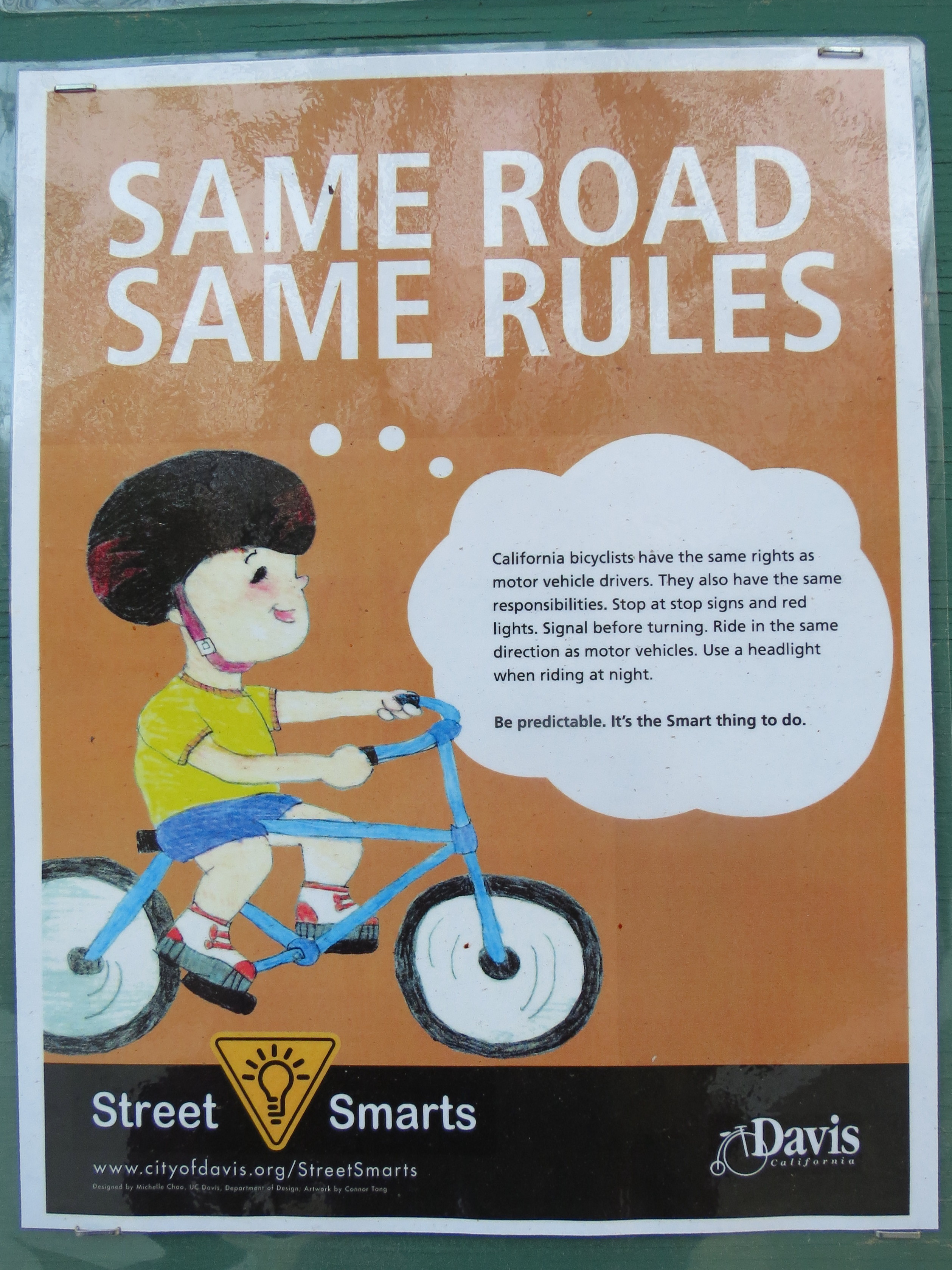

Sunset on a Davis Greenbelt
March 21st, 2013

We had a little rain yesterday ...

There was just something about the light that caught my eye.
March Madness, Day 17
March 18th, 2013

Beautiful day for a training ride!
I am pretty close to being on target for Davis Bike Club March Madness. As of today, day 17, I am 49% to my goal of 750 miles for the month.
Got a great training ride in today … Davis, Winters, Cantelow, Vacaville, Dixon, Davis for a total of 78+ miles. I rode pretty strong today … do I have to admit that I did have to walk up that last little bit of Cantelow? My excuse … I haven’t been doing hills and I’m not quite used to the gearing on my new bike yet. OK, lame. I know, I know.

Top of Cantelow
I’ve got a bit of work to do before the Napa Valley Tour de Cure … I have just 8 weeks left to get ready!
This is a great ride – if you’ve never done an organized ride, this is a great one to try! It is a fundraising ride – to raise money for the American Diabetes Association. To find your local tour and to register, click here. You’ll have an awesome ride, supported by amazing volunteers, and be supporting a great cause!