Archive for the ‘Breads’ Category

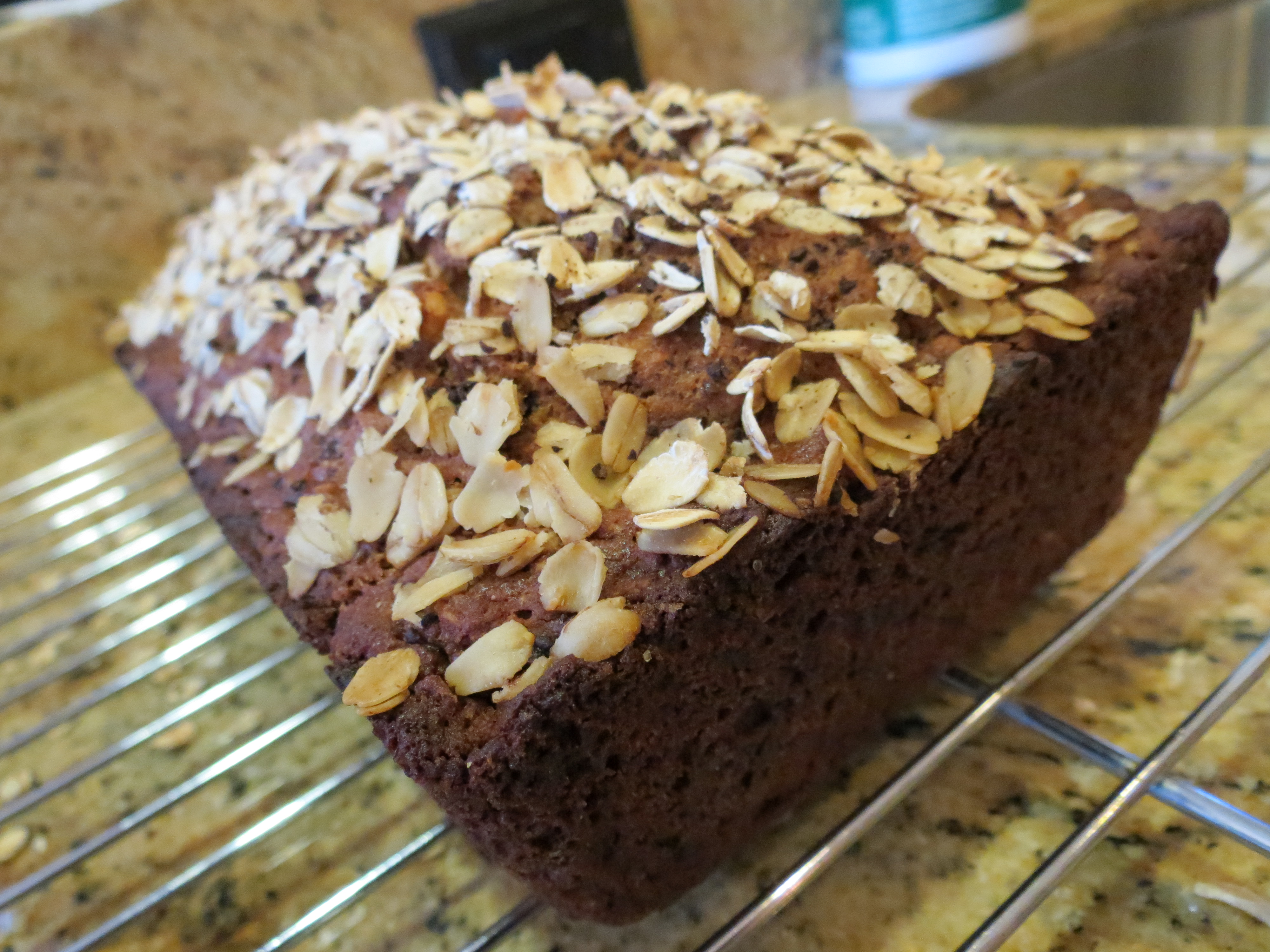
Whole Wheat Banana Nut Bread

Saturday, April 20th, 2013

It wasn’t supposed to be so breezy in Davis today, but it is. I really should be out there riding, getting ready for my Tour de Cure ride that is now just 2 weeks away, but I’m hoping the winds will calm down later. Perhaps a morning trip to the Davis Farmers’ Market? In the meantime, laundry and experimenting with my new favorite banana bread recipe are keeping me plenty busy.

Whole Wheat Banana Oat Bread with Walnuts

* My idea of ripe & ready for bread bananas.

1 1/2 cups whole wheat flour
1/3 cup coconut sugar
1/3 cup pure cane sugar, unrefined
1 1/2 teaspoons baking powder
1/4 teaspoon baking soda
1/4 teaspoon salt
1 teaspoon cinnamon
1 tablespoon instant espresso
3/4 cup whole rolled oats
2 ripe* bananas, mashed
1/3 cup buttermilk
1/4 cup vegetable oil
1 tablespoon vanilla
2 eggs, beaten
1/2 cup coarsely chopped walnuts
A handful of oats and some additional sugar for sprinkling on top of the loaf before baking

  1. Preheat oven to 350 degrees. Prepare the loaf pan – spray with cooking spray.
  2. Combine the dry ingredients in a large mixing bowl.
  3. Mash the bananas in another bowl, stir in the beaten eggs, buttermilk, oil, and vanilla. Mix well.
  4. Add the wet ingredients to the dry ingredients and stir until just combined. Fold in the walnuts. Don’t over-mix or the bread will be tough.
  5. Pour into prepared loaf pan. Sprinkle the top with a handful of oats and sprinkle with about 1 tablespoon of sugar.
  6. Bake in the center of the preheated oven for about 50-55 minutes. The loaf is done when a toothpick inserted in the center comes out clean.
  7. Cool on a wire rack for about 15 minutes, then remove from the pan. Let the loaf cool before slicing into it.

Add the wet ingredients to the dry ...

Fold in the walnuts ...

Fresh from the oven.

Let the loaf cool 10-15 minutes before removing from the pan.

You can slice it while it's still warm, but do try to be patient.

This bread is a bit more dense than the last version, due to the 100% whole wheat flour and walnuts, but it’s hearty, not heavy. The espresso and cinnamon add a nice complexity and depth of flavor, without being overpowering. Using coconut sugar, as well as bananas at this stage of ripeness, gives the bread a nice banana flavor without making it cloyingly sweet.

Enjoy with a freshly brewed cup of coffee, espresso, or cappuccino!

Banana Oat Bread

Sunday, April 14th, 2013

I’ve got a cold so I won’t be doing much riding today … oh, well. I guess it’s best to get it over with before my Tour de Cure ride! I had been fighting the cold all week, it seemed to start winning Thursday night and Friday, but seriously oversleeping on Friday and then early, early to bed Friday night and I thought I had turned a corner. I went for a pretty good ride yesterday (78.1 miles total). Certainly not a record-setting ride in any sense, but I rode steadily and reasonably strong, given the circumstances.

What to do to keep busy today? I have lots of chores I can do, but I’m looking for something a little fun, too. I’ve got some ripe bananas, a whole lot of oats, and some buttermilk I really need to use. So … a quick Google search “banana oat bread” turned up a few ideas.

Smells good!

Banana Oat Bread

1 cup whole wheat flour
1/2 cup all purpose flour, unbleached
1/3 cup coconut sugar
1/3 cup pure cane sugar, unrefined
1 1/2 teaspoon baking powder
1/4 teaspoon baking soda
1/4 teaspoon salt
2 teaspoons of apple pie spice blend
3/4 cup whole rolled oats
2 ripe* bananas, mashed
1/3 cup buttermilk
1/4 cup vegetable oil
2 teaspoons vanilla
2 eggs, beaten
A handful of oats and some additional sugar for sprinkling on top of the loaf before baking

  1. Preheat oven to 350 degrees. Prepare the loaf pan – spray with cooking spray.
  2. Combine the dry ingredients in a large mixing bowl.
  3. Mash the bananas in another bowl, stir in the beaten eggs, buttermilk, oil, and vanilla. Mix well.
  4. Add the wet ingredients to the dry ingredients and stir until just combined. Don’t over-mix or the bread will be tough.
  5. Pour into prepared loaf pan. Sprinkle the top with a handful of oats and sprinkle with about 1 tablespoon of sugar.
  6. Bake in the center of the preheated oven for about 50-55 minutes. The loaf is done when a toothpick inserted in the center comes out clean.
  7. Cool on a wire rack for about 15 minutes, then remove from the pan. Let the loaf cool before slicing into it.

Allow to cool most of the way and use a sharp serrated knife.

This bread is moist and has a nice, tender crumb.

Using the whole grain flour and coconut sugar, as well as the spices, produces a darker loaf than if you’re using all white flour and sugar. My first attempt at this recipe and it is a keeper! It is hearty, yet light and wholesome. It is flavorful and not too sweet. This is a variation of a recipe I found online here.

Napa Valley Tour de Cure, 2012

Three weeks from today I will be riding in my 5th Napa Valley Tour de Cure. I feel quite unprepared for the ride this year and I am not even close to my fundraising goal. I’ve got just 3 weeks to get ready. Here’s hoping I am 100% over this cold by next weekend, and that the weather cooperates! I am really, really hoping for good weather again this year for the Tour de Cure.

* A note about “ripe” bananas … I am really, really fussy about bananas. I like to eat them at the perfect ripeness (for me) – a lovely yellow peel, no (or at most very little) green, and no (or at most very few) brown speckles. Once there are more than a few brown speckles, they’re too ripe for my tastes for just eating. They’re OK for smoothies, and with a few more speckles, perfect for bread. So, that’s what I consider “really ripe” and ready for banana bread. If your bananas’ peels are entirely brown (or *gasp* black) and the flesh is mushy, they’re too ripe. Overly ripe bananas can give your bread a heavy texture.

Multigrain Bread Recipe

Wednesday, April 3rd, 2013

This past weekend I made a variation on the Tassajara Bread recipe. You can mix this dough by hand, or use a stand mixer. If you’re using a mixer, make sure it’s got a strong motor. I have a KitchenAid professional model, and this dough was just about all it could handle. You might want to make a half batch if you’ve got a smaller mixer, or are mixing it by hand.

Multigrain Bread

3 cups filtered water, room temperature
1 1/2 tablespoons active dry yeast
1/4 cup honey
1 cup dry milk
1/2 cup pumpernickel flour
1/2 cup oat bran
1/2 cup millet
1/2 cup polenta
2 cups high protein whole wheat flour
4 teaspoons kosher salt
1/3 cup butter, melted & cooled
3-4 cups whole wheat flour
1 cup white bread flour for kneading

  1. In the bowl of a stand mixer, sprinkle the yeast over 1 cup of the water and let it stand about 10 minutes.
  2. Add the honey, dry milk, and remaining water and mix a bit to dissolve the milk powder.
  3. Mix in the pumpernickel flour, oat bran, millet, polenta, and 2 cups of high protein whole wheat flour. Mix until the ingredients are well incorporated, but don’t over mix at this stage. You don’t want to develop a lot of gluten yet. Let rest for about 20-30 minutes. You can use either the paddle or dough hook for this stage, but you will probably find that the paddle mixes the sponge together a bit easier than the hook.
  4. Sprinkle the salt on top of the sponge, pour in the melted butter, then turn the mixer on low. You’ll want to use the dough hook at this point.
  5. Just out of the mixer

    When the salt and butter are mostly incorporated, begin adding the flour, about 1 cup at a time. This is going to be a pretty sticky dough, but remember that the millet, polenta, and oat bran will continue to absorb moisture as the dough mixes and proofs. Avoid the temptation to make the dough feel “right” just out of the mixer. It should be pretty soft and a bit sticky.

  6. Mix on low for about 10-15 minutes, then turn the mixer on high for about 2 minutes. Don’t walk away from the mixer at this point, though it might be tempting to do so.
  7. Turn the dough out onto a lightly floured board and shape into one large round. Place in a large, lightly oiled bowl, and cover with plastic wrap and a towel. Place in a draft-free area. I prefer to let my dough rise slowly, so I don’t go out of my way to find a warm place in my kitchen to proof the dough.

  8. Allow the dough to rise about 50 minutes or so, until it’s doubled in size.

Ready to "punch down."

To “punch down” the dough, gently push down on the dough to press out the excess gas. Then, gently lift the dough and tuck the sides under. You’ll do this so that you pretty much form a squarish envelope shape. Keep the smooth side up. Gently press down on the dough again with the palms of your hands, to help seal the bottom. Recover with the plastic wrap and towel. Let the dough rise until doubled in size again for 30-45 minutes.

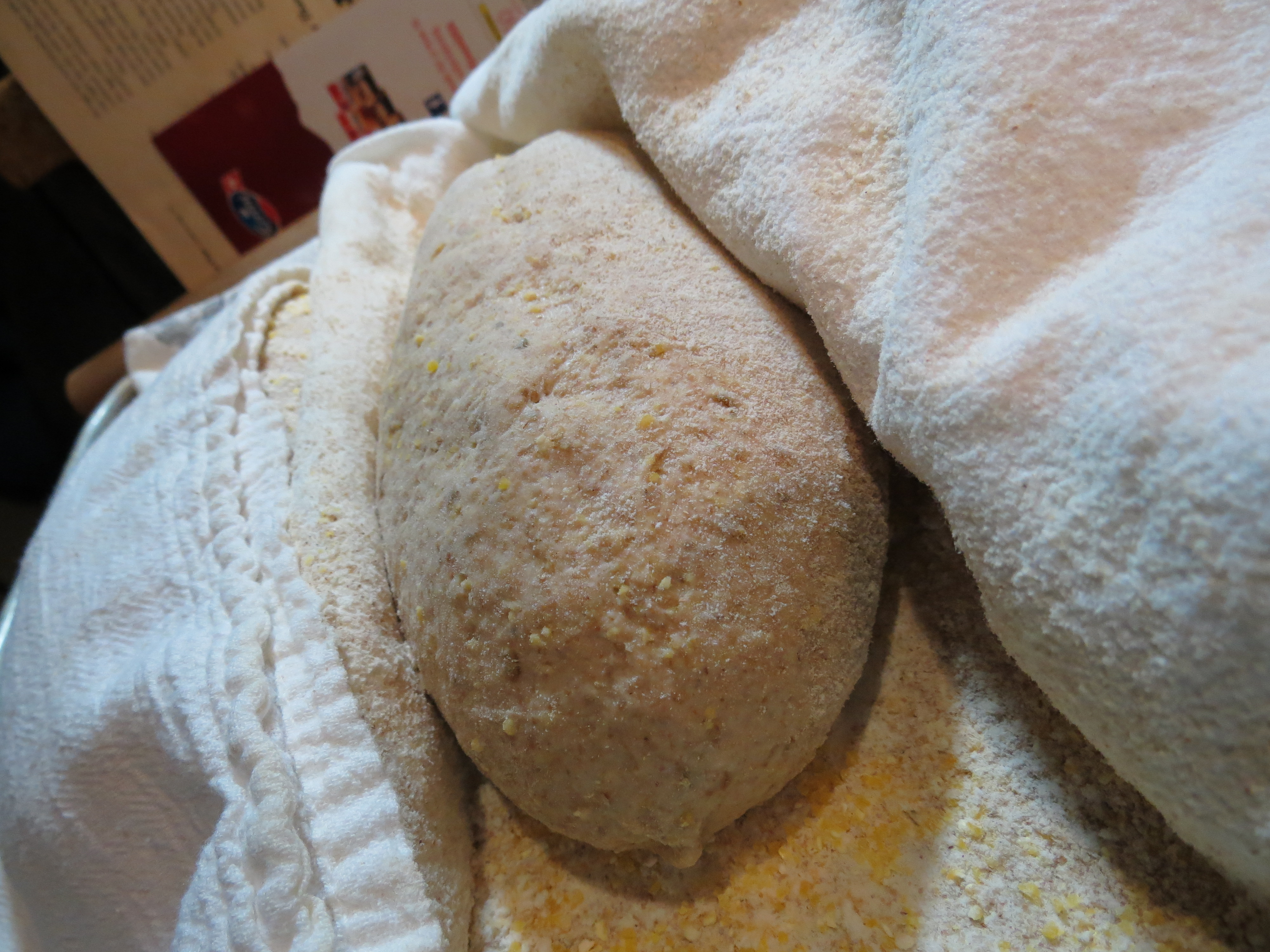
My make-shift "flour sack" couche, dusted with whole wheat flour, rolled oats, and polenta.

When the dough has just about doubled in size again, you’ll shape it. I like to shape into a basic loaf shape, sometimes called a “miche.” You can also shape the dough into rounds (“boule”), if you like. Once the dough is shaped, you’ll set it aside for its final rise. Again, times will vary. Since I can only bake at most 3 small loaves at a time, I will shape some a little tighter. These will rise a little slower. That way, I have time to proof and bake the first loaves. They’ll take about 30 minutes to rise, and then another 20-30 to bake.

If you time it just right, the second half will be perfect and ready to go in as you pull out the first loaves.

To bake the dough, use a hot oven (400 to 450 degrees) and preheat it well. For smaller artisan style loaves, use a preheated baking stone or tile. You’ll want a slightly lower temperature for a large loaf baked in a pan. I also like to throw a couple of ice cubes on the bottom of the oven immediately after I put the dough in to bake. Be sure to shut the oven door right away to hold the heat and steam in. This simulates a steam-injected oven that professional bakeries use to create that wonderful crust.

One large loaf, proofed and ready!

Egg wash will give the finished loaf a nice, shiny glaze.

This batch makes enough for two large loaves (9.5 x 5.5 x 2.5-inch loaf pans). I always like to make a few smaller loaves and proof them in towels dusted with polenta and flour. This mimics an artisan loaf that you’ll find in a good bread bakery. You’ll want to use either linen couches or some basic “flour sack” type towels.

I usually make two or three smaller, rustic loaves, and one large loaf. It is important to use a very sharp knife (or better yet, a razor blade) to get nice, even scores on the dough. Scores should be about 1/4 to 3/8-inch deep, depending on the size of the loaf. This will result in a beautiful finished loaf.

Homemade bread may seem intimidating, but this recipe really is pretty forgiving, and is great for bread bakers of every level! Proofing times are estimates and will depend on various factors, including the temperature of the water you use and the room temperature.

You CAN make artisan quality bread at home!

Look at that beautiful glaze!


Multigrain Bread

Monday, April 1st, 2013

Today was a great day for baking and doing a bit of much needed spring cleaning.

Early afternoon the sky began to clear ...

Oh, my! Now I was glad I'd stayed home!

The weather was rather unpredictable today. We had wind, rain, sunshine, thunder & lightning, and downpours. There were moments when I wished I was outside riding, but then the skies opened up and I was thankful to be home and safe and dry.

The recipes and photos will have to come later because WordPress has decided to stop working and won’t post photos correctly, but I had a busy day in the kitchen with homemade whole grain bread, chocolate chip cookies, and kale slaw – getting ready for a potluck at work tomorrow.

Kale Slaw

Multigrain Bread

Chocolate Chip

An Adventurous Weekend

Monday, February 4th, 2013

It was a weekend full of surprises and adventures.

Yikes. Really hoping that Trek will cover this under warranty. I bought my Trek 5000 in 2009, so I am within the 5-year warranty period. The Trek shop in Davis (Freewheeler) is going to submit a claim on my behalf.


Just a little roll on some Davis country roads on Saturday afternoon. A lovely day! Wish I had been up for more.

Saturday ... A little dough experimentation ... Whole Wheat & Rye Piadine Dough with fresh thyme and fennel seeds.

Fennel seeds have lots of health benefits, one of them being they are soothing to the belly. Just enjoy it in small amounts.

Sunday … got a longer ride in, but no photos. Then, home and baked a batch of bread to share as a thank you gift. This is another variation of the Tassajara whole wheat bread recipe I’ve used for years. This one has whole wheat, pumpernickel, millet, rye, and a bit of polenta. It made for wonderful toast this morning!

Sunday ... Whole Wheat, Pumpernickel, Millet, and Oat.

The weather was incredible this weekend for cycling – not too cold, not too warm, not too windy. All in all … if I could do it over again, I would! I’ll just have to wait 5 days. I’m super busy at work … they’ll go fast.

Speaking of going fast … training time for the 2013 Napa Valley Tour de Cure sure is flying by! Just 3 months to go!!! Please support me in this ride – you can make a donation here:  http://tour.diabetes.org/site/TR?pg=pfind&fr_id=6830

Multi-Grain Bread

Tuesday, January 22nd, 2013

Fresh from the oven ...

This bread is being shipped to a very special someone in Ohio.

Multi-Grain Bread

For the sponge:
3 cups filtered or bottled water, room temperature
1 1/2 tablespoons yeast
1/4 cup honey
1 cup non-fat dried milk
1/2 cup pumpernickel flour
1/2 cup oat bran
1/4 cup polenta
2 1/4 cups whole wheat flour

In the bowl of a stand mixer, add water and sprinkle the yeast over the water. Allow to soften a bit. Add the honey, milk, oat bran, polenta, and flours. Using the paddle attachment, mix until well blended. Don’t overmix at this point, you don’t want to develop a lot of gluten yet.

Allow to proof about 20-30 minutes.

For the dough

4 teaspoons kosher or sea salt
1/3 cup butter, melted and cooled
2 cups whole wheat flour
1/2 to 1 cup unbleached white bread flour

Change to the hook attachment. Sprinkle the salt on the sponge, add the melted butter. Begin mixing on low speed and add the whole wheat flour, 1/2 cup to 1 cup at a time. Mix on low until the flour is well incorporated and the dough is a soft, slightly sticky texture. Use the unbleached bread flour, adding as needed, to achieve the texture you want. I tend to like wetter doughs, but for this batch, I did use the entire cup of unbleached white bread flour an it felt perfect.

Mix on low for about 7 to 10 minutes, then turn on high speed and knead for 3 minutes. The 7 to 10 minutes will vary, depending on the flours you use. Making bread is not always a science, it’s a tactile art. You have to develop a “hand memory” for what feels right in a dough.

Remove the dough from the mixer and shape into one large round. Place in a large bowl that’s lightly oiled. Cover with plastic wrap and then a towel. Allow to rise for 45 minutes to an hour, or until it’s about doubled in size. At this stage, if you are in a hurry, you can shape the dough. It will have better flavor and texture, though, if you do a second rise. “Punch down” the dough – gently press down on the dough, then lift it up and tuck the sides under the top. Recover with plastic wrap and a towel, then allow to double in size again. This will take anywhere from 30 minutes to an hour, depending on the the room temperature, dough temperature, and wetness of the dough.

Preheat the oven to 450 degrees. Place a baking stone or inverted heavy duty sheet pan in the oven when you begin to reheat. You’ll want it hot when you put the dough in the oven.

Miches, in make-shift couches.

Shape the dough. For this batch, I made four miches – a basic loaf – and let them rise in a flour and polenta dusted make-shift couche of flour sack cloth towels. Again, the rise time will vary on the same factors. Since I can only bake two loaves at a time in this oven, I shaped two loaves tighter so they would take longer to rise.

I let the first two rise about 20 minutes (these were the more loosely shaped loaves). Score the loaves, and just before transferring them to the preheated stone in the oven, drop 3 or 4 ice cubes in the bottom of the oven and close the door quickly. This will mimic the effect of a professional steam-injected oven that professional bakeries use. Working quickly, transfer the scored loaves to the preheated stone and close the oven door. You don’t want to lose that heat and/or steam.

Bake about 8 to 10 minutes, then rotate the loaves for even baking. Bake another 8 to 10 minutes. The loaves are done when a gentle tap on the bottom makes a sort of hollow sounding thump.

By now, the more tightly shaped loaves were perfect. Allow the oven to reheat a bit, and follow the same process as above.

It is admittedly difficult to resist, but allow the loaves to cool completely (or at least almost) before cutting.

To preserve the crust, avoid wrapping directly in plastic. I’ll wrap these loaves in parchment paper, then in plastic, for shipping.


Mushroom Pizza

Monday, January 21st, 2013

As promised, here is follow-up on the mushroom pizza.

Solano Mushroom Farms, organic mushrooms

At the Davis Farmers’ Market, I stopped by the Solano Mushroom Farm table and picked up some gorgeous organic mushrooms. I chose a combination of (from top left): maitake, shiitake, royal trumpet, and oyster mushrooms. The shiitake and royal trumpet mushrooms provide a nice, meaty texture, and the maitake and oysters a lighter, more delicate texture. They all provide great nutrition and flavor.

Another stop on my way yesterday was the Davis Co-op (http://davisfood.coop/). This is my go-to store for bulk foods. They have a great selection of flours, grains, and different rices that I like to keep on hand.

I made a variation of the Piadine dough I’ve been using for pizza.

Whole Wheat Rye Piadine Dough

2 1/4 teaspoons active dry yeast
1 1/2 cup cool water
1/4 cup Rye
3/4 cup Whole Wheat
2 1/2 cup White Bread Flour
1/2 Guisto’s High Protein Whole Wheat
2 tablespoons Organic Extra Virgin Olive Oil
2 teaspoons kosher salt

I got a little distracted and wasn’t paying attention. I added all of the flour at once, rather than leaving some of it out until the end. Ooops … my dough was a quite a bit tighter than I usually make it, but I decided to go with it. I did add about another tablespoon of olive oil while it was mixing. This isn’t my usual method, but this is what I did for this batch:

  1. Sprinkle the yeast over the water to dissolve.
  2. Combine the flours.
  3. Add the flour to the water and mix on low, using the hook attachment.
  4. Add the olive oil and continue to mix on low.
  5. Realize that the dough was way too dry, and add about 1 more tablespoon of oil.
  6. Mix on low until all ingredients are well combined (this took about 8-9 minutes).
  7. Sprinkle the salt on the dough, then turn the mixer on high and mix about 3 minutes.
  8. Turn the dough out on a lightly floured board, shape into a round, allow it to set a moment, then cut in half and shape each half into a ball.

The initial shaping ...

Getting ready for the second rounding ...

This is enough dough for two large pizzas. Round the dough into two balls, place each in an oiled bowl large enough to allow the dough to double in size. Cover with plastic wrap, and place in the refrigerator. The dough is best left to rise in the refrigerator for at least 8 hours (overnight is better), or if you need it sooner, you can let it rise at room temperature. It would be ready in about 1 1/2 to 2 hours, depending on room temperature, the temperature of the water, and so on. Allowing the dough to rise in the refrigerator will allow more flavor and a better texture to develop. You’ll want to take the dough out of the refrigerator about an hour before you plan to shape and cook it.

So, I’d had a busy morning already … Davis Farmers’ Market, a stop at Davis Wheelworks (http://www.daviswheelworks.com/), Davis Food Co-op (http://davisfood.coop/), and making the dough. Now it’s time for a ride.

We rode to Winters and back. I had a new saddle for my Colnago, a Terry Butterfly. The ride was going great! I rode a lot stronger than I thought I was going to be able to – I haven’t been getting much cycling in since I hurt my knee in November. It felt GREAT to be out there. It was a beautiful day, I had wonderful company, and am loving my new bike! We made our usual stop in Winters, at Steady Eddies, shared a Coke and an oat cake, playfully gave a stranger a bad time about where he parked his bike, then headed back Putah Creek Road. Then a funny thing happened. Within minutes after my cycling partner took off on a sprint, something started to feel funny. Somehow my saddle position had changed and I was riding way too far back. I stopped and discovered that my saddle had come loose. Oh, dear. I had no idea how to fix this, and no tools. So I waited. I knew he would come back … eventually. So I waited. Then I called … and called … and called … and then my phone wouldn’t work … stupid Verizon. In the time I waited, about 5 cyclists rode past. I am happy to say that all but one asked if I needed help. The last one to stop was the first one to have the tools to fix my saddle. Just as he was fixing it, my cycling partner rode back up and recognized this cyclist as the stranger we chatted with at Steady Eddies. You just have to love the kindness of strangers!

So, we got home, got cleaned up, and I went to find the perfect wine for the pizza. I went to Nugget and got there minutes after the Wine Guy left for the day. A back up wine guy made a few suggestions. I ultimately decided on an Aquinas 2010 Napa Valley Pinot Noir. This did go nicely with the pizza, but I think an earthier pinot would have been nice, too.

Let the sauteed mushrooms cool a bit

I sliced the mushrooms and sauteed them for about 3 minutes in a bit of organic extra virgin olive oil. I added a touch of fresh thyme towards the end of the saute. You’ll want to let these cool before placing them on the pizza dough. You are going to want to preheat your oven to at least 450 to 500 degrees. It depends on your oven how long this will take, but just be sure that the oven and pizza stone are well preheated before baking your pizza. If you’re making a thin crust pizza, you’ll want to place the stone towards the top of the oven. If you’re making a thicker crust, you’ll want to be towards the middle. If you place the rack too close to the bottom of the oven, you may cook the bottom but not the top of the pizza. There is a huge amount of variation in home ovens, so this may take some practice to get it just right.

There are lots of techniques for shaping pizza dough. I always do this by hand, not with a rolling pin, because I want to keep some bubbles in the dough. I like to keep an edge all the way around, and you can’t really do that using a rolling pin, either. I don’t pull in the dough, but rather gently stretch is, using my fists on the underside of the dough. Just after high school, I worked in a couple of pizza restaurants and learned how the professionals do it. You will want to work quickly or the dough will stick to the peel. You’ll want to flour the peel and I like to sprinkle some polenta on it, also. That will help prevent sticking and the polenta adds a nice crunch to the finished pizza.

The shaped pizza dough.

Top with Quattro Formaggio

Add sauteed mushrooms.

Add smoked mozzarella & freshly ground black pepper.


Slide the pizza from the peel onto the preheated baking stone. One of the tricks I learned was to gently shake the peel side to side a bit before sliding the pizza off onto the stone. This will let you know if the dough has stuck to the peel. The more quickly you can work once the shaped dough has been placed on the peel, the less likely it is to stick.

Slide the prepared pizza from the peel onto the preheated baking stone. Bake about 8 minutes, then check the pizza and rotate it front to back to ensure even cooking.

Bake until the crust is golden brown and the cheese is well melted. I like the cheese to get just a bit browned.

The finished pizza.

I usually slide the pizza onto a cooling rack for a moment before cutting it. This just helps it to set up and keeps the crust a little crispier. This pizza had no sauce, so there was little risk of it getting soggy. We didn’t want to wait long to cut this one.

Serve with some mixed greens and tomatoes lightly dressed with a balsamic vinaigrette.

We will definitely make this again!


Organic Mushrooms from Solano Mushroom Farm

Sunday, January 20th, 2013

These beauties are going on the pizza tonight ...

Mushroom Pizza, Anyone?

Saturday, January 19th, 2013

Lately I have been craving mushrooms. This morning’s trip to the Davis Farmer’s Market this morning yielded a beautiful array of organic mushrooms: Royal Trumpets, Oysters, Shiitakes, & Maitakes.

I’ve got some homemade whole wheat & rye dough rising, and we’re just about to head out for a nice ride on this gorgeous day.

I’ll post pictures later!


Whole Wheat, Polenta, Oat & Pumpernickel Bread

Monday, January 7th, 2013

Ready To Bake

Recipe to follow soon …