Archive for the ‘Breads’ Category

Homemade Soup & Bread Weather is Here!

Sunday, December 23rd, 2012

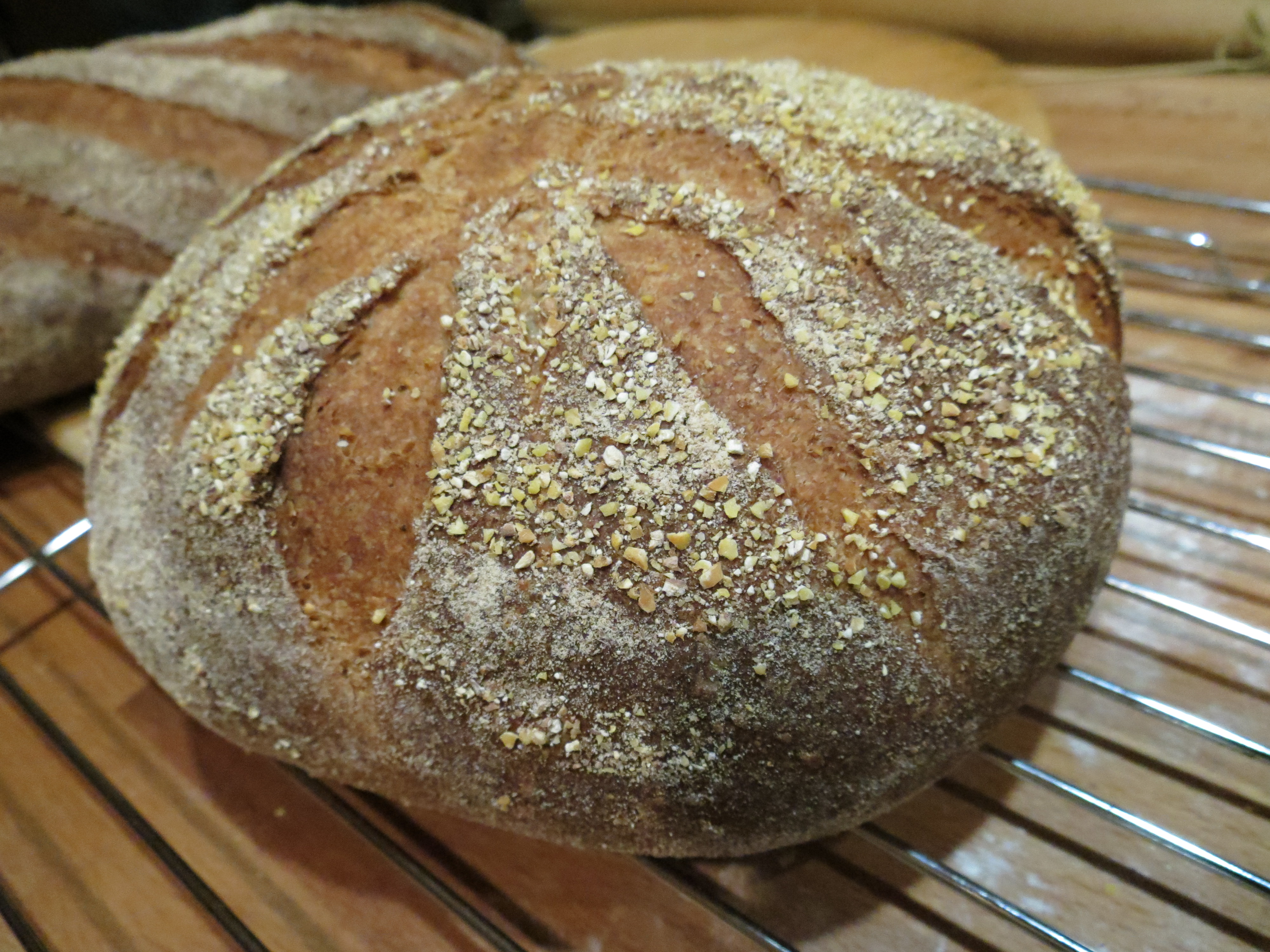
If ever weather called for homemade soup and bread, it is now. We’ve been having quite the little storm here in Northern California, so yesterday I made a super healthy chicken vegetable rice soup and a batch of whole wheat bread with a hint of oat bran, polenta, and pumpernickel.

Hearty, healthy, and delicious!

For the soup, I precooked some short grain brown and black rice in my rice cooker (positively one of the best kitchen inventions EVER!). I sauteed in a little olive oil some carrot, celery heart, and crimini mushrooms just to soften a little. I set these aside, and in the same big soup pot, I sauteed 3 chicken sausages and about 4 ounces of leftover herbed chicken breast from the night before. I used Trader Joe’s chicken sausages (2 sundried tomato and 1 smoked apple chardonnay, but you can use whatever brand or flavor you like). I sliced them into about 1/4-inch slices, then in half, and sauteed them just enough to heat them through and brown them just a bit for flavor. I added back the vegetables, about 1 cup each of frozen peas and green beans, and some baby kale, chard, and spinach  (Trader Joe’s Power to the Greens), and some fresh thyme. I sliced a few cherry tomatoes in half (Trader Joe’s heirloom cherry tomatoes), then used about 2 1/2 quarts of organic chicken stock (Kirkland brand). I let it cook gently while I finished up the bread.

The bread is based on the Tassajara Bread recipe, with a couple of variations.

3 cups filtered or bottled water, room temperature
1 1/2 tablespoons dried yeast
1/4 cup honey
1 cup dry milk
1/2 cup oat bran
1/2 cup polenta
1/2 cup pumpernickel flour
1 1/2 cup whole wheat flour

4 teaspoons salt
1/3 cup butter, melted & cooled
2 cup whole wheat flour
1/2 to 1 cup flour
additional flour as needed for kneading

Prepare the sponge:

  • Add the honey to 1 cup of water, then sprinkle the yeast over top. Set aside for the yeast to soften and begin to dissolve in the water (5-10 minutes).
  • Combine 2 cups of the water, dry milk, oat bran, polenta, pumpernickel, and 1/2 cups whole wheat flour. Gently stir to make a smooth mixture, but be careful to not over-mix at this point.
  • When the yeast has dissolved, stir together the water, honey, and yeast mixture and then add to the bran, polenta, and flour mixture. Again, stir to make a smooth mixture, but don’t over-mix.
  • Cover with a towel and set aside to proof about 15 minutes.

While the sponge is proofing, melt your butter, then set aside to cool. Combine 2 cups of whole wheat flour with the salt. When the sponge looks “proofy” (starting to bubble and rise), add the melted butter on low speed (or stir in by hand) until mostly combined. Then, add the flour and salt mixture 1/2 to 1 cup at a time. If you’re using a mixer, do this on low speed. If you doing it by hand, stir it in with a large, heavy wooden spoon. When you can no longer stir it in with the spoon, you can work it in with your hands.

Just out of the mixer

This dough turned out to be fairly wet, so I ended up using at least 1 cup additional flour.  It’s important to go by feel, not just by measurement when you’re making bread. It takes some practice, but once you get the feel of dough, you just know. Flour varies a lot by brand and type, so you can’t always measure exactly and expect consistent results. I used a combination of King Arthur and Guisto’s flours; both are premium flours. King Arthur flours are available in pre-packaged bags, and Guisto’s flours are usually in bulk.

Both of these brands are available online:
Guisto’s:  http://giustos.com/home_baker
King Arthur:  http://www.kingarthurflour.com/

I mixed this dough a long time on low because it was so wet, then finished it with about 3 minutes on high speed. I used my KitchenAid stand mixer, but this is a great dough to do by hand, also. It’s very satisfying to handle; it just feels good. Turn the dough out onto a floured board. You want to use enough flour to prevent the dough from sticking, but be careful to not use too much; you don’t want to work too much more into the dough.

The polenta adds a nice, slightly sweet crunch.

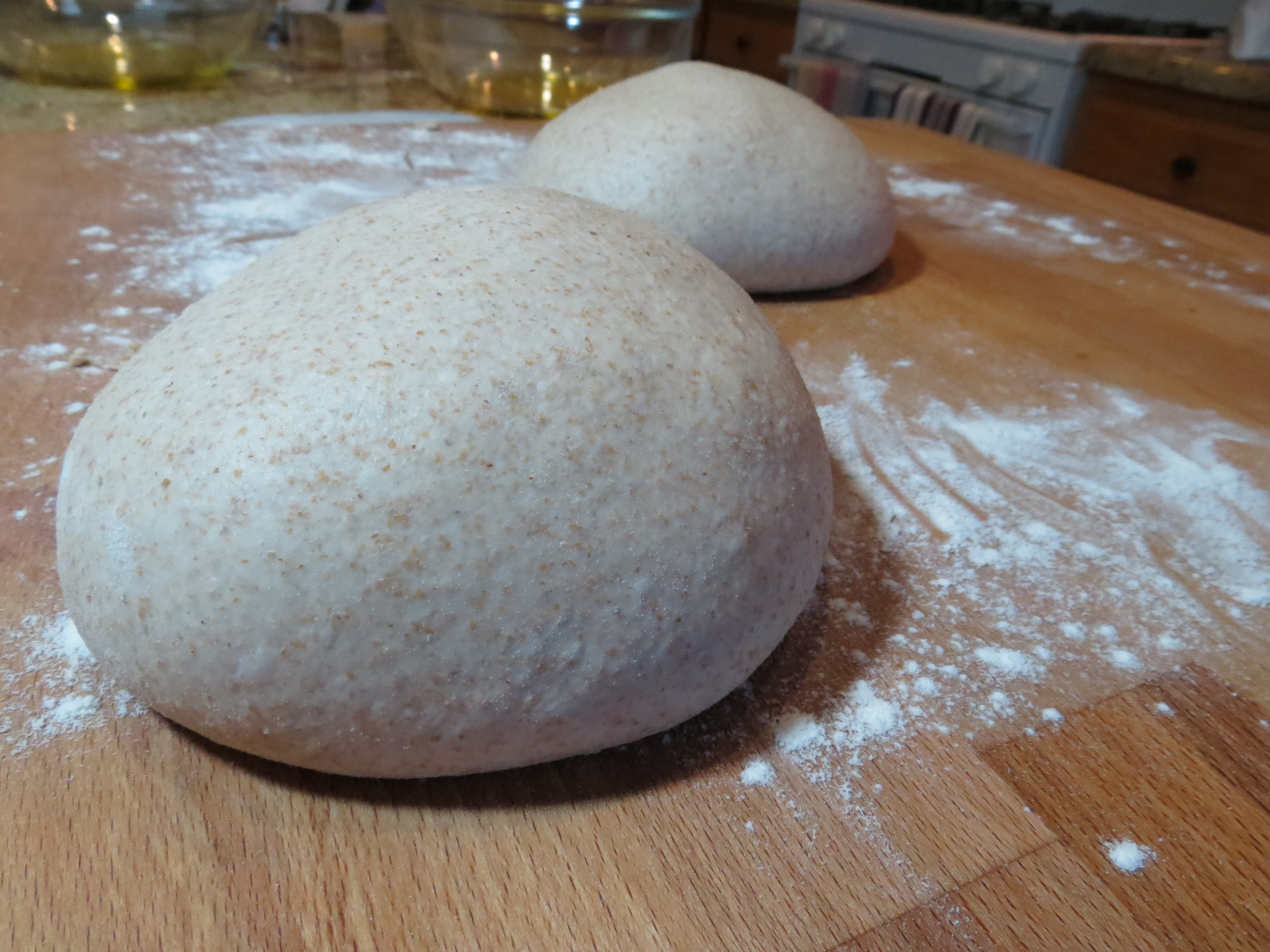
After the first rise.


Shape the dough into one large ball and place in a large, lightly oiled bowl. Cover loosely with plastic wrap, then with a towel. Allow to rise about 45 minutes, then “punch down” the dough by gently pressing down on it. Then, fold the dough over itself, keeping the smooth top up. Recover and allow to proof another 45 minutes to 1 hour.

This batch will make two large loaves (9 1/4 x 5 1/4-inch loaf pan), or as many smaller loaves, or rolls, as you care to make. I like to use about half of it in a loaf pan, and then make 1 or 2 more rustic loaves that I proof in a baker’s couche (a linen cloth made for proofing yeast doughs). You can use a towel (the flour sack kind, NOT terry cloth!) to create a make-shift couche. Generously flour the couche. For this dough, I used whole wheat and pumpernickel flours, and for one of the loaves I also sprinkled on some polenta. Place the shaped dough top down (seam up) on the floured couche.

My make-shift couche, dusted with whole wheat and pumpernickel flours, & polenta.

Free form loaf.


Cover loosely with towels so the loaves don’t dry out too much. With the couche, the dough will dry out just enough to allow a really nice crust, but you want to make sure you don’t expose the dough directly to the air or it will dry out, creating an unattractive crust. If you’re using loaf pans, you’ll want to cover lightly with plastic wrap. Remember, the dough will rise again, so you don’t want to restrict it by covering it too tightly.

The dough will need to rise about 30 minutes, so start preheating your oven after about 20 minutes. You’ll want to bake the rustic, couched loaves first. They’ll need a hot oven (400-450 degrees) and a preheated baking sheet. If you have a baking stone or tile, that’s best, but you can also turn a professional sheet pan over and place that in the oven while it’s heating. A half-sheet pan will fit in most home ovens. I have one that I have sacrificed for this; it’s the oldest of the sheet pans I have, so it’s not in great shape, anyway, but it works like a charm for this.

When the oven is ready, place a sheet of foil on a baking peel and gently transfer the dough to the peel. This dough is sturdy enough that you can do this by hand, but if you have a delicate dough (like a ciabatta) you will want to use a hand peel to transfer the dough from the couche. Place the dough seam down on the foil. Score with a razor or very sharp knife.

Ready to score ...

Ready to score ...

Scored and ready to bake!

Transfer the scored loaves to the oven. I bake them on the foil on the inverted, preheated baking sheet. You want to keep as much heat in the oven as possible, so quickly spritz the dough with water or throw a couple of ice cubes on the bottom of the oven. If you use a spray bottle, be very, very careful to NOT spray the light bulb in the oven! It will shatter and your bread will be ruined. I speak from experience. After about 5 minutes, you can throw 2-3 more ice cubes in the bottom of the oven, or spritz with a little more water. What this does is to help to mimic that nice, chewy crust you get in breads baked in a professional oven.

Bake until the loaves are a nice, golden brown. They’re done when they sound hollow when you give the loaf a little thump on the bottom crust.

Fresh out of the oven. Smells so good!

Be sure to allow the bread to cool at least most of the way before you slice into it.

Now here is a little slice of heaven!


This will
warm you,
fuel you, and
nourish you.
Enjoy!


Whole Wheat Bread …

Sunday, December 23rd, 2012

Smells so good!


… with a little polenta, pumpernickel, and oat bran.

Full post to follow …it’s time for dinner!


Another Variation on the Piadine Dough …

Sunday, November 4th, 2012


After 3 minutes at high speed, it's perfect!


Just out of the mixer ... notice how much flour is on the board. You may be tempted to dump lots and lots of flour on your board, but resist!

This afternoon I am trying another variation on the Piadine Dough. I increased the whole wheat and rye flours, used unbleached all-purpose flour instead of bread flour, and used Annie’s Naturals Roasted Garlic Flavored Extra Virgin Olive Oil (see:  https://www.alice.com/buy/1276139-annie-s-naturals-green-organic-roasted-garlic-flavored-extra-virgin-olive-oil) instead of regular extra virgin olive oil. It looks and smells fabulous! I used a sponge method for the dough.

For the original recipe for Michael Chiarello’s Piadine Dough, from his The Tra Vigne Cookbook, see:  http://www.napastyle.com/recipe/recipe.jsp?productId=2342.

This recipe makes enough dough for one large pizza, two medium pizzas or focaccias. One of these days I will try ciabatta with this dough. I think it will make an amazing ciabatta!

Whole Wheat Rye Piadine Dough

2 1/4 teaspoons active dry yeast
1/2 cup water
1/4 cup rye flour
1 7/8 cup whole wheat flour
1 cup water
2 tablespoons Annie’s Naturals Roasted Garlic Flavored Extra Virgin Olive Oil
2 teaspoons kosher salt
1 cup all-purpose flour (unbleached)
Flour for kneading, up to about 1/2 cup including your bench flour

Make the sponge:
Sprinkle the yeast over the water and let it stand until it is dissolved. Add the rye and whole wheat flours, about 1/4 to 1/2 cup at a time and stir until you have a smooth, thick batter. If you are using a stand mixer, such as a KitchenAid, you might want to use the paddle for this step, rather than the hook attachment. Let rest to allow the yeast to proof. I was a bit pressed for time today, so I only let it stand about 10 or 15 minutes. Normally, I would let it stand 30-45 minutes.

Mix the dough:
Add 3/4 cup of the remaining flour. If you’re using a stand mixer, use the hook attachment and low speed at this stage.  In a separate small bowl, stir the salt into the remaining 1/4 cup of flour and set aside. When the flour is mostly mixed in, add the olive oil, mix a bit, then sprinkle the remaining 1/4 cup flour and salt into the dough. Continue to mix the dough on low speed for 3-4 minutes. You’ll want to stop and scrape the dough from the hook a time or two during this stage. After 3-4 minutes, turn the mixer to high speed and knead on high for 3 minutes. You’ll want to sprinkle in a little flour while it kneads, but be careful to not add too much (no more than 1/8 to 1/4 cup).

Just out of the mixer.

Turn the dough on onto a floured board (see above). This is a wet dough, so you want to have enough flour on your board to prevent sticking, but don’t be tempted to over flour the board. This dough is a bit delicate and deserves a very light touch. You will find that it comes together very quickly and is easily shaped into a round. When you’re first learning, you may be frustrated when dough sticks to your hands, but patience and practice will pay off. It’s almost as if your hands develop a non-stick coating after a while.

First shaping

If you're making 2 pizzas or focaccias, cut the dough in half ...

... then shape each piece into a round.

Place each round in an olive-oiled bowl, cover with plastic.

This dough can be left at room temperature to proof right away, or be refrigerated overnight for use the next day. It will proof pretty quickly, depending on the temperature in your kitchen, and the temperature of the water you use. I like to use cool water for my breads, and rarely use warm water. If you are using the dough right away, the first rise will take 45 minutes to one hour, until it doubles in size. Gently punch down the dough and fold the sides under to once again create a smooth top. Then, let it rise again until it just about doubles in size again. Shape into focaccia, or use as pizza, or … try something new! Tonight, I’m making a simple rosemary and sea salt focaccia, which I have to go prepare right now. Tomorrow, I’ll try ciabatta.

Enjoy!

By the way … for you Costco shoppers out there, Costco now carries Annie’s Naturals Roasted Garlic Flavored Extra Virgin Olive Oil in 1-liter bottles.

Experimenting on the Grill

Sunday, October 28th, 2012

Heirloom Cherry Tomatoes, Romaine Lettuce, Whole Wheat Bread, & Yam

Getting ready for a little experimental grilling ...


This will become …

Grilled Ceasar Salad with Grilled Heirloom Cherry Tomatoes and a Roasted Garlic Ceasar Dressing, and Whole Wheat Croutons (somebody ate the day old Pugliese I had planned for the croutons)

Grilled Yams … a healthier twist on sweet potato fries


Whole Wheat, Rye, & Oat Bran Bread

Monday, October 22nd, 2012

One dough, three results.

This is a variation on Edward Espe Brown’s The Tassajara Bread Book whole wheat bread. That was my first ever bread book; I highly recommend it for anyone who wants to learn bread basics. It has easy to follow step-by-step instructions for the beginning baker, and lots of ideas on modifications for the more advanced baker as well. I’ve tried most of bread recipes in this book and have never been disappointed. See:  http://www.shambhala.com/the-tassajara-bread-book-1.html.

I used my KitchenAid stand mixer; it’s the large capacity Professional model. If you’ve got a standard KitchenAid, you’ll want to cut this recipe in half; it is probably too much for a standard home mixer to handle.

For the sponge:
½ cup buttermilk
2 ½ cups water (use filtered or bottled)
1 ½ tablespoons yeast
¼ cup honey
1 cup dry milk
½ cup rye flour
½ cup oat bran
2 ½ cups whole wheat flour

For the dough:
4 teaspoons kosher salt or sea salt
1/3 cup oil or butter
2 cups whole wheat flour
1/2 to 1 cup unbleached bread flour

For kneading:
up to 1 cup all-purpose flour (“bench” flour)

Mise en place.
Assemble all of your ingredients.

Prepare the sponge:
Measure the buttermilk and water into a large bowl. Sprinkle the yeast over the water and let dissolve. In a separate bowl, stir together the flours and oat bran. When the yeast has dissolved, stir in the honey and dry milk. Then stir in the flour and mix until a thick batter forms. You don’t want to over mix at this point. Proof the sponge 45 minutes.

Just out of the mixer. It was quite sticky!

Mix the dough:
Fold in the salt and oil. I usually use unsalted butter in this recipe, but I used sunflower oil in this batch because that’s what I had. For the salt, whenever possible I use kosher or sea salt. Always use a fine grain salt, never coarse. Fold in the oil and salt for a moment, then begin adding the remaining 2 cups whole wheat flour and 1/2 to 1 cup unbleached bread flour.

If you’re using a stand mixer, mix on low until the ingredients are well incorporated, then turn on high and knead on high for about 2 minutes. This is a sticky dough, so you’ll need to stop the mixer a few times and scrape the dough off the hook. If you’re mixing by hand, you’ll knead this dough about 10 minutes. One thing to remember is that even though the dough feels sticky at this point, you don’t want to add too much more flour because the whole grain flour and oat bran will absorb moisture as the dough rises.

After kneading, before the first rise.

When you’re done kneading, gently shape the dough into a ball and let it rest a moment while you oil a large bowl. Place the dough in smooth side down to lightly coat with the oil, then gently turn the dough over. Cover the bowl with plastic wrap, then cover with a damp towel. Set aside to rise for 50-60 minutes, or until doubled in size.

After the first "punch down" ... notice how the dough is folded over itself.

When the dough has doubled in size, gently punch it down. With loose fists, gently press into the center of the dough, then gently press all the way around the dough ball to deflate it. Pick up the dough, and gently fold the sides under. Turn the bowl ¼ turn, then fold the remaining sides under. Recover the bowl with plastic, cover with the damp towel, and set aside for the second rise. The dough will again double in size in about 40-50 minutes.

When the dough has doubled in size again, it’s time to shape it.

Shape the dough:
This recipe makes 2 large loaves, but you can also make other shapes. I made 4-5 ounce buns (for turkey burgers), 1 rustic loaf (about 1 pound), and 1 large loaf (about 1 ½ pounds).

The buns, proofed, egg washed, scored, and ready to go in the oven.

For the buns, I shaped them into rounds then gently pressed them down a bit, put them on an aluminum foil lined sheet pan, sprayed them with a little non-stick spray, covered with plastic, and placed a second sheet pan on top to weight them down. That’s how you get a nice bun shape, rather than a high puffy round. I set these to rise about 30 minutes, then brushed them with a little egg wash, scored them with a sharp knife, and baked them at 350° for about 30 minutes.* They’re done when they turn a nice, golden brown color, and sound hollow when given a gentle thump on the bottom crust.

The miche on the couche, after proofing.

The rustic loaf ready to go into the oven.

For the rustic loaf, I shaped into a “miche” (see below) and proofed in a make-shift couche (say, “coosh”). A couche is the special canvas cloth used by artisan bakers; it’s in part what gives their breads that amazing chewy crust.  I generously sprinkled a flour sack kitchen towel with all-purpose flour and a little whole wheat, and placed the loaf seam up in the center of the towel, then loosely wrapped the cloth around the dough. I set this aside to proof about 45 minutes. Then, baked it at 350° for about 40-45 minutes.*

You want to support the sides of the dough, especially if you have a more delicate dough and normally you’d make more than one loaf this way, but I’ll go more into that another time. I’ve not made this dough using a couche before, so this was an experiment. I was quite pleased with the result, so I’ll certainly be doing this again. The crust was near perfect!

Rustic Loaf ... beautiful crust can be yours at home!

The rustic loaf had a nice, even crumb, and a chewy crust. The couche is worth the little extra effort!

If you’d like some more information on using a couche, here is a pretty good basic video on couching technique: http://www.youtube.com/watch?v=hZAwSV1VakA.

In the loaf pan, before the final rise.

For the large loaf, I also shaped this into a “miche” and then placed it to rise in a large loaf pan. You’ll probably want to spray the loaf pan with a little non-stick spray first. This took about an hour to rise. I scored the loaf with a razor, then brushed the top with egg wash before baking.   I baked it at 350° for about 45-50 minutes.*  I turned the oven off, left the door open, and allowed the loaf to sit in the oven for about 15-20 while it cooled down. It browned more quickly than I expected, so I wanted to make sure it was cooked thoroughly.

The knife I used to score the rustic loaf wasn’t as sharp as it needed to be, so you can see that the scores are not as nice and even as they really should be. The best tool to do this with is a razor – just be very careful! If you look at the picture at the top of this post, you can see how clean the cuts are in the large loaf. These cuts were made with a razor rather than a knife.

*I’m pretty sure the oven I’m working with right now runs hot, so these cooking times and temps may need to be adjusted. I’ll have to buy an oven thermometer.

Shaping a “Miche”

The miche, just after shaping, before placing in the loaf pan. Notice the seam on the bottom. This one is pretty well sealed, but you can smooth it a little more by gently rolling the loaf, seam side down, on your board.

Gently shape the dough into a rectangle. For this dough, you want to gently press most of the gas out of the dough, but not all of it. Begin rolling towards you, tucking the ends gently with your thumbs when necessary, and pressing along the seam with your thumbs while you roll the dough. When you reach the end, gently push one end in with your thumb, and then press gently with the heel of your hand to seal it. Gently press with the heel of your hand along the seam, while tucking the dough in with the thumb of your other hand. Then, gently roll the dough to smooth out the seam. If you are going to proof this on a couche, then place it seam side up on the couche. If you are proofing this in a loaf pan, place it seam side down in the pan. Proof. Bake. Cool. Enjoy!


Dough Variation – Whole Wheat & Rye Piadine Dough

Saturday, October 13th, 2012

Here’s the variation on the Piadine Dough I made on Thursday. This recipe makes enough for 2 focaccias or pizzas (10-14 inch diameter, depending on how thick you like your crust).

2 1/4 teaspoons rapid rise yeast
1/2 cup water
2 tablespoons rye flour
1 cup whole wheat bread flour
1 7/8 cup bread flour (2 cups – 2 tablespoons)
1 cup water
2 tablespoons extra virgin olive oil
2 teaspoons kosher salt
1 cup additional bread (or all purpose) flour, if needed for handling

Mise en place*

Combine the rye, whole wheat, and 1 7/8 cup bread flours.

Sprinkle the yeast over the 1/2 cup of water, stir in 1/2 cup of flour mixture until smooth and set aside for about 15 minutes.

While the yeast is proofing, begin the autolyse:  place the remaining 1 cup water in the bowl of a stand mixer fitted with a hook, not paddle. Add the remaining rye/wheat/bread flour mixture and mix on low until combined. You don’t want to overmix at this stage. You do not want to develop the gluten, just allow the water to hydrate the flour. (Note: I was a little concerned when I first did this because it seemed quite dry, but that turned out to be OK, the end result was lovely!)

When the yeast has proofed, pour the mixture into the mixing bowl, add the olive oil, and mix on low speed. It may take a few minutes for the mixture to come together, but it will. You may need to stop the mixer and scrape the dough off the hook and sides once or twice until the dough comes together (starts to look smooth and evenly mixed). Depending on your mixer, this may take 5 or more minutes on low. When the dough is smooth, add the salt and mix about 30-seconds to 1-minute on low until the salt is mixed in. If necessary, turn off the mixer and scrape the dough off the hook. Then, turn the mixer on to high speed and knead for 2 minutes on high.

Whole Wheat & Rye Piadine Dough

Flour a board and turn the dough out onto the board. Let it rest just a moment, then gently shape into a ball. This is a wet dough, so it will come together quite easily. Let it rest a moment, then divide into two pieces, gently reshape into balls, and set to rise in olive-oiled bowls. Cover with plastic. If you are going to use the dough right away, then set it to rise at room temperature. When it doubles in size, gently deflate the dough by pressing down with your fists or palms. Cover the dough again and set it to rise again. When it’s nearly double in size again, then it’s ready. You can skip the “punching down” if you’re in a hurry and just use the dough after the first rise. If you are going to use the dough later, or the next day, then place it in the refrigerator right away. You’ll want to “punch it down” when it’s almost doubled in size, and then return it to the refrigerator.

So far I’ve been using this dough for focaccia and pizza. I think it will also make a lovely ciabatta, also, but I’ve got to get my couches out of storage, and also need to get a new hand peel. I think it would make nice small rolls, too, but I don’t know that it would hold a shape (baguette, batard, boule, etc..) very well because it is such a wet dough. Although, there is a free form baguette shape that would work. I can’t remember the name, but I think it’s an Italian style. I’ll have to play with this, but as I recall, it’s similar to shaping ciabatta, but you cut the dough into longer strips and then gently stretch it into a baguette-like shape.

One thing for certain about this dough is that it requires gentle handling and TLC.

Now … enough goofing off it is time to get outside and enjoy this gorgeous autumn day!

* Mise en place = “to put in place” (i.e., get all your stuff together before you do anything else.)

Time for Chicken Soup

Friday, October 12th, 2012

Hopefully this will fix things so I can ride this weekend …

Homemade Chicken Soup, with mahogany rice, ginger, and vegetables.

A variation on the Piadine Dough. I doubled the rye and whole wheat, and reduced the white bread flour. I also tried a slightly different method, sort of combining an autolyse and sponge methods. I'll post details later.


Looky What Just Went in the Oven …

Tuesday, October 9th, 2012

Focaccia with heirloom cherry tomatoes, green olives, fresh thyme, black sea salt, and some really good extra virgin olive oil.

Focaccia & Minestrone Soup

Monday, October 8th, 2012

Tonight I made a variation on the dough I made a few weeks ago (see:  http://cyclingfoodie.com/2012/09/guess-whats-for-dinner-tonight/). I used 1 tablespoon of rye flour, 1/2 cup of whole wheat flour, and the rest (except for dusting) unbleached bread flour. Oh, this dough feels, smells, and tastes amazing.

Fresh out of the mixer ...

Gently shaped ...

Getting ready for the first rise ...

Fully risen ...


Gently shaped and dimpled for focaccia ...

... a few green olives, a little coarse sea salt, a generous splash of extra virgin olive oil ...

Voila! The finished focaccia.


Preheat your oven to 400 degrees Fahrenheit. Allow the focaccia to rise about 10-15 minutes while your oven heats. Bake about 25-35 minutes.

A twist on Giada's Winter Minestrone Soup ... see http://www.foodnetwork.com/recipes/giada-de-laurentiis/winter-minestrone-recipe/index.html


Serve with fresh, hot Minestrone Soup. Tonight’s soup is a  twist on Giada’s Winter Minestrone Soup. I had to  substitute some ingredients (baby kale for chard) and I didn’t quite follow the exact proportions (doubled the tomatoes). All I can say is that it sure smells good in here now.

It’s Getting to be Soup Time!

Saturday, October 6th, 2012

There’s a cool breeze tonight that’s leaving me longing to make some soup this weekend. I have some beautiful baby kale, so I’m thinking a modified Minestrone? Oh, how I wish I had all of my cookbooks here so I could use my favorite Minestrone recipe. It’s from a book called “Soup Salad & Pasta” by Ursel Norman. This is one of my favorite cookbooks.

My Tassajara Bread (circa April 2010)

Oh, and bread … definitely some bread, too. I’m thinking some Tassajara whole wheat …  a true classic. The ultimate comfort food. The Tassajara Bread Book was my very first bread book. What I love about this book is that it gives very detailed directions on basic bread making skills. Once you master these basic skills, the world is your loaf!

I miss my cookbooks … sigh …